British Columbia is selling its Small-Scale Multi-Unit Housing legislation as the cure for the affordability crisis. But as a contractor doing the actual work, well, the math tells a different story.
Run the numbers on a standard North Vancouver infill project, and the logic starts to unravel fast. This isn’t a straightforward path to affordable housing. It’s a complex, expensive building model being imposed on aging neighbourhood infrastructure that was never designed to handle it, and the costs land squarely on developers and, ultimately, buyers.

The Build: What It Actually Costs
Take a typical 7,000-square-foot buildable lot. Under the new R3 Houseplex zoning, maximizing density means building multiple kitchens, bathrooms, and laundry facilities to meet provincial requirements. At $750 per square foot for construction and professional fees, that’s roughly $5.25 million in hard and soft costs alone. Add $1.5 million for land acquisition, and you’re looking at a total project cost of approximately $6.75 million — and that’s before GST, financing, or holding costs enter the picture.
Now divide that across units. At the provincial maximum of six dwellings — achievable only near a frequent transit stop — each unit costs about $1.125 million just to break even. Drop to four units on a less favourable site, and that number climbs to nearly $1.7 million per door. These aren’t luxury condos with concierge service. These are the baseline numbers for modest infill housing before a single profit margin is factored in.
The Hidden Costs Nobody’s Talking About
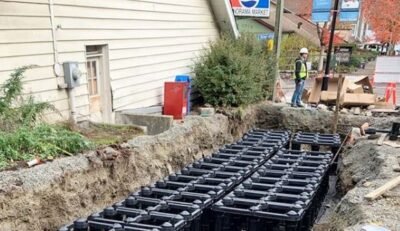
Part of why the math is so punishing is what contractors call the infrastructure surprise: much of North Vancouver’s underground network of water, sewer, and drainage pipes was built before 1970. Upgrading those systems to handle six times the original residential load isn’t just technically complicated — the costs are largely unknown until you’re already committed to a project, and municipalities are increasingly offloading those costs onto the development.
Sign up for news alerts from North Shore Daily Post
Electrical infrastructure presents a similar problem. BC Hydro distribution networks and neighbourhood transformers weren’t built for blanket densification. Upgrading them is expensive, and finding space for pad-mounted transformers on a small urban lot quietly eats into both your buildable area and your budget.
Then come the development charges. Under the current District of North Vancouver bylaws, SSMUH projects are classified under the townhouse category, triggering roughly $65,000 per unit in municipal levies before a shovel breaks ground.
Who Is This Actually Affordable For?
When the entry price for a “small-scale” unit exceeds one million dollars at cost, the word affordability starts to lose meaning. What the province is describing as a housing solution for working families is, in practice, producing luxury multiplexes accessible only to buyers who can still clear an increasingly punishing mortgage stress test.
The fundamental problem isn’t zoning. It’s everything layered on top of it — development charges, infrastructure upgrade requirements, utility constraints, and a regulatory process that adds time and cost at every turn. Until those layers are seriously examined and reformed, changing what’s permitted on a lot won’t change what people can afford to pay for it.
Erik Jensen is the founder and CEO of Sprucehill Homes.