







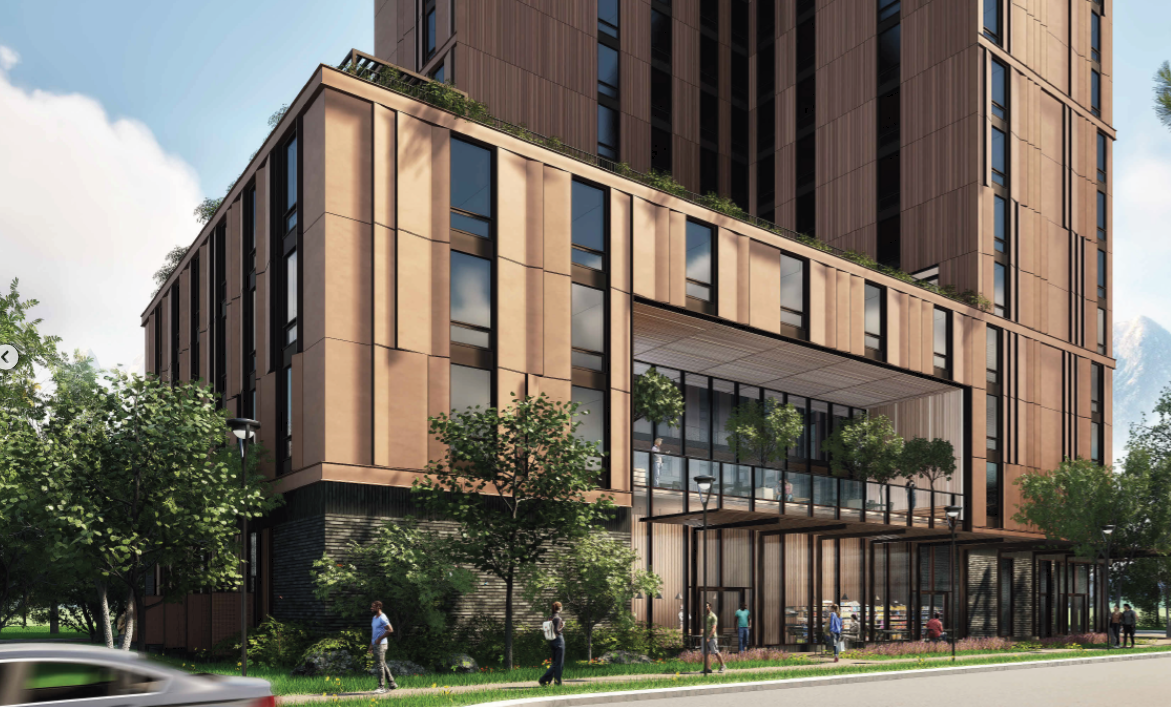
District of North Vancouver council will vote on Monday on a 21-storey student housing proposal at 1578-1590 Hunter Street that would provide no parking stalls for its 426 residents. District staff have flagged a series of unresolved technical issues across parking, affordability, infrastructure and design, and are not recommending immediate approval.

The proposal would house Capilano University students in 426 micro-units ranging from 160 to 220 square feet. The plan includes 20 visitor stalls, but no resident parking and no loading stalls.
Sign up for news alerts from the North Shore Daily Post
In a report to the council, staff say they have not received adequate justification for the zero-stall approach and have raised concerns about the volume of ride-share, food, and goods deliveries associated with more than 400 students in a neighbourhood where street parking is already limited.
Site access remains unresolved. The developer wants vehicle and garbage access from Orwell Street, citing safety and intersection alignment. Staff, by contrast, want to preserve that section of Orwell Street as an active-transportation-only route to complement a proposed “Green Spine” linear park, setting up a geographical tug-of-war over how the site connects to the surrounding street network.

Affordability is another sticking point. The developer is requesting a density of 5.5 FSR, more than double the official community plan limit of 2.5. Council has previously indicated it might support that level of density in exchange for below-market housing, but the current proposal includes no below-market units. The developer argues the micro-units are inherently more affordable, though they would rent for up to $2,000 a month, a rate of more than $10 per square foot.
Staff have also identified an infrastructure gap, citing known capacity issues with local sanitary and storm sewer systems. The developer has not yet paid the fees required to begin the utility modelling needed to assess those concerns, leaving the scope of any required upgrades unclear.
The proposal also falls short of district accessibility guidelines. District policy recommends 100 percent basic and five per cent enhanced accessibility for multi-family housing, while the proposal offers five per cent basic and no enhanced units. On design, the tower’s L-shaped floorplate exceeds the district’s 30-metre maximum width guideline, raising concerns about view blockages and shadow impacts on the surrounding area.
Staff acknowledge a demonstrable need for student housing to reduce bridge congestion but are asking council to direct administration to work with the developer on the outstanding issues — including below-market housing, transportation impacts, infrastructure upgrades and architectural design — before any formal bylaws are introduced. Depending on how long those negotiations take, staff note that bylaw introduction may not occur until after the 2026 municipal election.




THERE MUST BE PARKING PROVIDED!!!!!!!!!
As proposed, absolute lunacy……..if actually built, likely to be one of the first towers to be torn down, replaced with legitimate housing.