



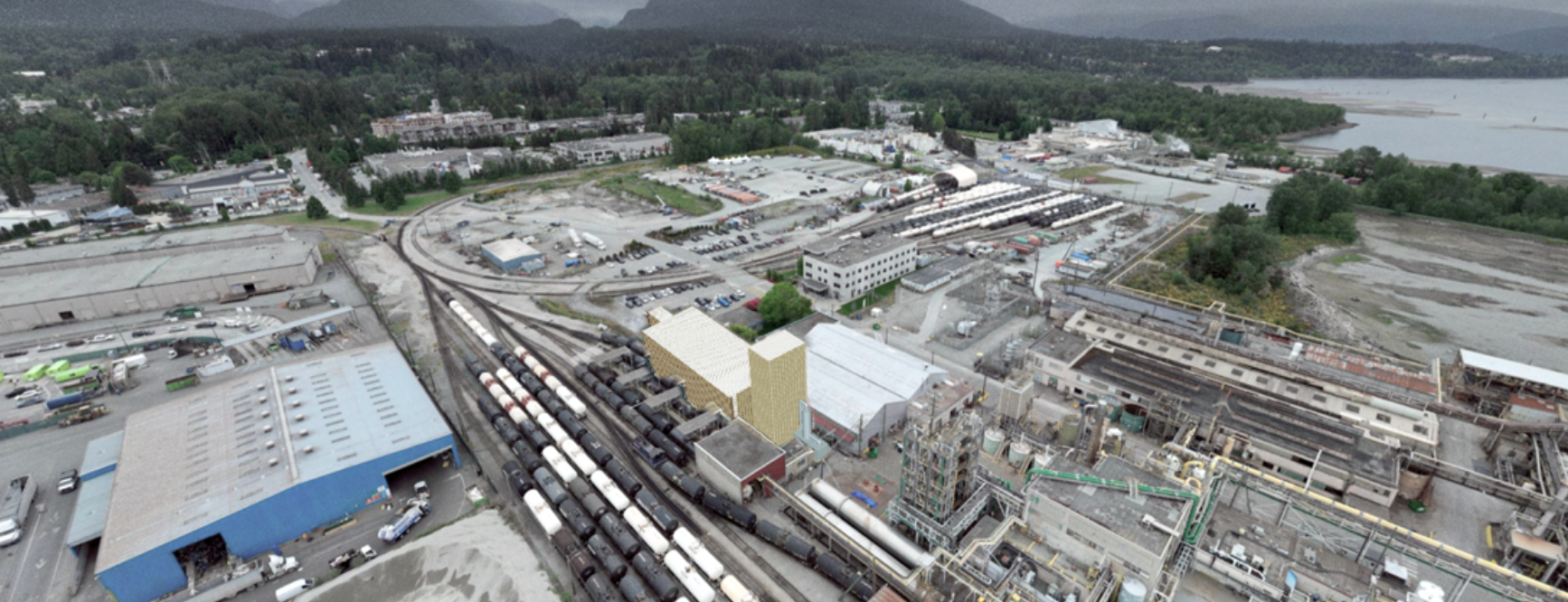
A re-zoning to permit the continued manufacture of liquid chlorine at the Chemtrade facility in North Vancouver (100 Amherst Avenue, near Maplewood) proved to be the most controversial decision of the North Vancouver District Council this term. The process involved two separate votes of Council (each 4-3 votes, the first opposed and the second allowing the re-zoning), two multi-evening Public Hearings with dozens of presenters, pro and con.

At issue was the continued operation of the Chemtrade liquid chlorine facility in North Vancouver in the Maplewood neighbourhood. The facility has operated on this site since 1957. Changes in the land-use requirements of the Vancouver Fraser Port Authority (who lease lands to Chemtrade for port purposes) required Chemtrade to move a portion of their manufacturing facility onto adjoining District lands triggering the need for re-zoning.
The decision brought out many voices, pro and con. Liquid chlorine is a dangerous substance which, if released into the atmosphere, can cause injury or even death, depending on the amount released, the prevailing winds, and the proximity to population. Liquid chlorine is also a necessary component in the manufacture of bleach, which is necessary to the purification of drinking water.

The Chemtrade facility manufactures 40% of Canada’s total production of liquid chlorine, and nearly 70% of the liquid chlorine used to purify drinking water (as a component of bleach) in British Columbia and Alberta. The facility is a major exporter of liquid chlorine to the United States. Other production facilities in Canada are located in Saskatchewan and Quebec and would not have the capacity to replace the liquid chlorine manufactured at the Chemtrade facility. Were the facility to close down, communities in British Columbia (including Metro Vancouver) would become dependant on liquid chlorine manufactured in the United States to make the bleach required to purify their drinking water.
The facility provides significant economic benefits to both the District of North Vancouver and to the region generally. The plant employs approximately 120 full-time staff, and pays significant taxes to all levels of government. However, everyone on Council was in agreement that the re-zoning would only be granted if Chemtrade could establish that the facility could operate with reasonable safety.

The proposal was carefully reviewed by two independent engineering consulting firms (Baker Engineering and Risk Consulting Inc), and included several production upgrades to increase safety, including the elimination of a 60-tonne on-site storage tank and transitioning to a “produce-and-ship” model, and the construction of an enclosed railcar loading facility. The engineering experts concluded that with these safety upgrades, a person is 40 times more likely to die in a motor vehicle accident, and six times more likely to die of food poisoning, as compared to the risk of death caused by the manufacture and shipping of liquid chlorine at this facility.
Of course, no risk can be reduced to zero. With the potential for major earthquakes, terrorist incidents, high-speed train derailments, human error and other unlikely events, there is always a chance of a mishap. The fact that the plant has operated safely for close to 60 years, and that to date no fatal incident involving chlorine manufacture nor transportation has been recorded in Canada, does not guarantee such an event will not occur in the future. In the Public Hearings we heard about hypothetical events that could, depending on wind conditions, result in a significant number of deaths, especially if a rail accident occurred near population centres. A former fire chief from Burnaby spoke about hypothetical events that could lead to 2,000 deaths from a catastrophic chlorine gas leak.
The Public Hearings attracted significant attention from speakers aligned with an industry competitor, who both spoke out against the project and who appeared to have a competitive interest in the matter. As I left District Hall after the first evening of Public Hearings, I saw persons who had spoken against the re-zoning (some coming from other places in Canada and the USA) entering a luxury bus provided (by someone) for their convenience.
At the first vote of Council (April 13, 2026), the re-zoning failed in a 4-3 vote, with Cllrs. Little, Muri, Forbes and Pope opposed, and Cllrs. Hanson, Back and Mah in favour. At a subsequent meeting, Mayor Little brought a Motion to bring the matter back before Council for re-consideration. After the vote to reject the re-zoning, Chemtrade came back with the proposal to include a Covenant under s. 209 of the Land Title Act, placing a time limit on the production of liquid chlorine at this site (2046, or the termination of the adjoining Port lease, whichever comes first) and for a requirement that the facility face ongoing risk assessments to ensure compliance with state-of-the-art safety requirements.
This lead to the matter going for yet another set of Public Hearings and then coming back before Council for another vote on July 6, 2026. At this meeting, Mayor Little switched his vote, and the matter passed 4 to 3.
For my part, I am pleased that Chemtrade will be able to continue operations and will continue to supply the liquid chlorine needed to ensure the safety of our drinking water without relying on imports from the United States. In my view, the facility (presenting a risk of death 40 times less than driving a car) is reasonably safe. Now is not the time, furthermore, to become dependent on our southern neighbour for safe drinking water. In my view, that is the more dangerous option.